In manufacturing, few things are more frustrating than reaching the assembly stage only to discover that your sheet metal parts simply don’t fit together as intended. Whether it’s misaligned holes, warped panels, or inconsistent bends, these issues can halt production, increase costs, and strain timelines.
Understanding why sheet metal parts fail to fit—and how to prevent or correct these problems—is essential for engineers, fabricators, and production teams alike. Let’s break down the most common causes and practical solutions.
1. Tolerance Stack-Up: Small Errors Add Up
The Problem
Every manufacturing process introduces slight variations. When multiple parts are assembled, these small deviations accumulate—a phenomenon known as tolerance stack-up. Even if each individual part is within spec, the final assembly may be out of alignment.
The Fix
- Design with realistic tolerances, not overly tight ones.
- Use Geometric Dimensioning & Tolerancing (GD&T) to define functional requirements clearly.
- Introduce slots or adjustable features instead of fixed holes in critical alignment areas.
- Perform tolerance analysis during the design phase.
2. Incorrect Bend Allowance or Bend Deduction
The Problem
Sheet metal doesn’t behave like a rigid material—it stretches and compresses during bending. If the bend allowance or bend deduction is calculated incorrectly, the final dimensions will be off, leading to mismatched parts.
The Fix
- Use material-specific bend tables based on real-world testing.
- Validate bend calculations with prototypes.
- Standardize tooling and bending processes to reduce variability.
- Use CAD software with accurate sheet metal simulation capabilities.
3. Material Variability
The Problem
Not all sheet metal is identical—even within the same grade. Variations in thickness, grain direction, and mechanical properties can affect how the material bends and behaves.
The Fix
- Source materials from reliable suppliers with tight quality control.
- Specify acceptable thickness tolerances.
- Align bend lines with or against the grain consistently.
- Test new material batches before full production runs.
4. Poor Tooling or Machine Calibration
The Problem
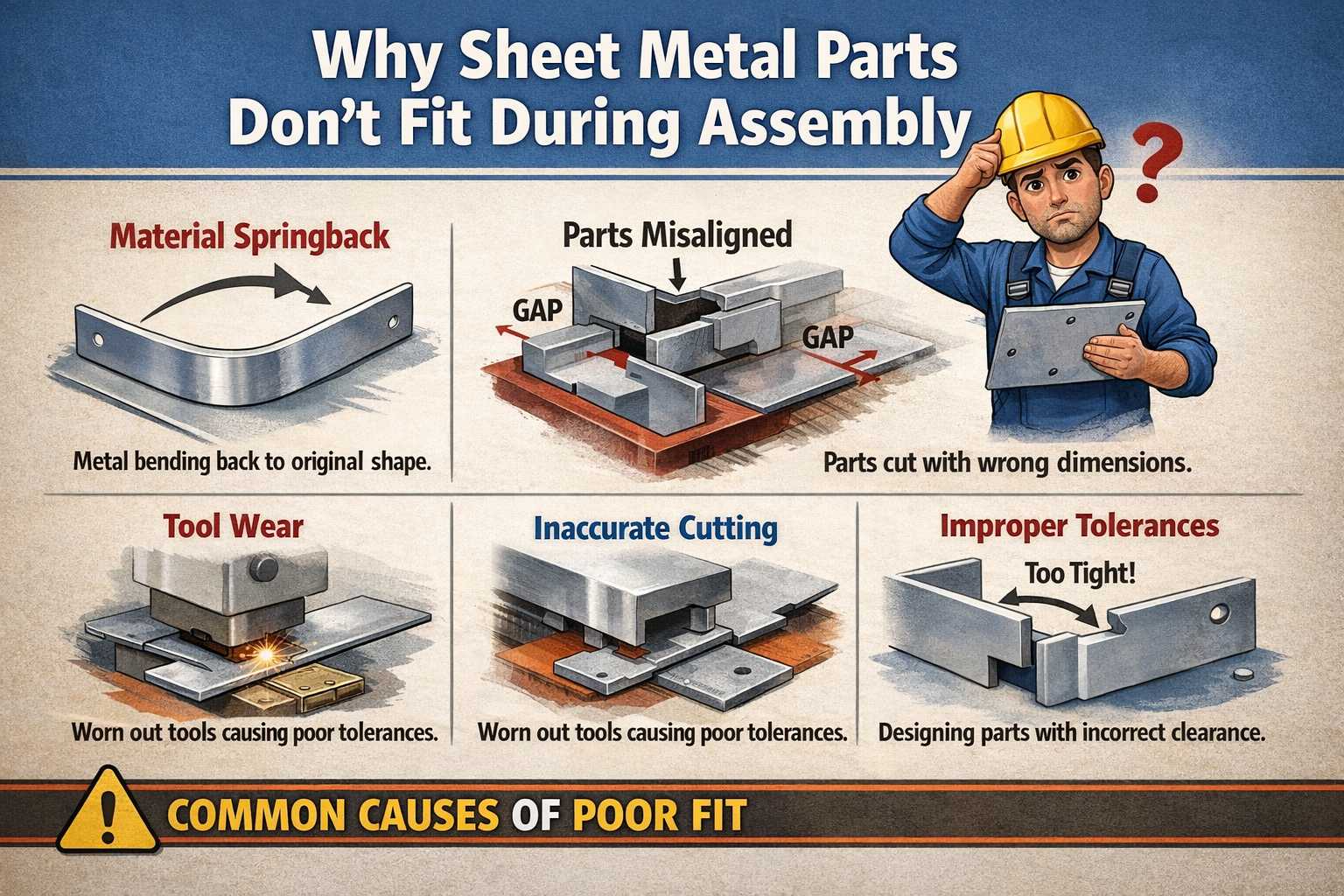
Worn or improperly calibrated tools can lead to inconsistent bends, inaccurate hole placement, and dimensional drift.
The Fix
- Regularly inspect and maintain tooling.
- Calibrate machines (press brakes, laser cutters, punch presses) on a scheduled basis.
- Replace worn dies and punches promptly.
- Use precision tooling for critical components.
5. Thermal Distortion During Cutting
The Problem
Processes like laser cutting or plasma cutting introduce heat, which can warp thin sheet metal parts. This distortion may not be obvious until assembly.
The Fix
- Optimize cutting parameters to minimize heat input.
- Use proper nesting strategies to reduce stress concentration.
- Allow parts to cool properly before further processing.
- Consider alternative cutting methods (e.g., waterjet) for sensitive parts.
6. Inaccurate Hole Placement
The Problem
Misaligned holes are one of the most common assembly issues. Even slight deviations can prevent fasteners from fitting or cause forced assembly.
The Fix
- Use CNC-controlled processes for higher accuracy.
- Avoid placing holes too close to bend lines unless compensated.
- Account for hole distortion during bending.
- Use fixtures or jigs during assembly to guide alignment.
7. Springback Not Accounted For
The Problem
After bending, sheet metal tends to partially return to its original shape—a behavior known as springback. If not properly accounted for, angles and dimensions will be incorrect.
The Fix
- Overbend parts slightly to compensate.
- Use simulation tools to predict springback.
- Adjust tooling and process parameters based on material behavior.
- Perform first-article inspections to validate results.
8. Assembly Process Issues
The Problem
Sometimes the parts are fine—but the assembly process isn’t. Improper sequencing, lack of fixtures, or inconsistent handling can create fit issues.
The Fix
- Define a clear assembly sequence.
- Use jigs and fixtures to maintain alignment.
- Train assembly personnel thoroughly.
- Implement quality checks during assembly, not just at the end.
9. Design for Manufacturability (DFM) Oversights
The Problem
Designs that look good on paper may be difficult—or impossible—to manufacture accurately. Sharp corners, tight bends, and complex geometries can lead to fit problems.
The Fix
- Involve manufacturing teams early in the design process.
- Follow DFM guidelines for sheet metal:
- Maintain consistent bend radii
- Avoid overly tight tolerances
- Simplify geometry where possible
- Prototype early and iterate quickly.
10. Lack of Prototyping and Testing
The Problem
Skipping prototyping to save time or cost often leads to bigger problems later during full-scale production.
The Fix
- Build and test prototypes before mass production.
- Conduct fit and function testing in real assembly conditions.
- Use feedback loops between design and manufacturing teams.
Final Thoughts
When sheet metal parts don’t fit during assembly, it’s rarely due to a single issue. More often, it’s the result of multiple small factors interacting—design decisions, material behavior, tooling conditions, and process control.
The key to preventing these problems lies in proactive collaboration, accurate modeling, and continuous validation throughout the product lifecycle.
By addressing the root causes outlined above, manufacturers can reduce rework, improve product quality, and keep production running smoothly.
Quick Checklist for Better Fit
- ✅ Validate bend calculations
- ✅ Perform tolerance analysis
- ✅ Maintain and calibrate equipment
- ✅ Use consistent materials
- ✅ Prototype before production
- ✅ Design with manufacturability in mind
If you’re consistently running into fit issues, it may be time to step back and evaluate your entire workflow—from design to final assembly. Small improvements at each stage can make a big difference in the final result.
Get Custom Sheet Metal Fabrication Services
At Blackstone Advanced Technologies, we’re committed to helping you build your vision. We’re the custom sheet metal fabrication you can count on delivering you exceptional results.
Request a quote and let’s get your product finished.
Discover more from Blackstone Advanced Technologies, LLC
Subscribe to get the latest posts sent to your email.